
Sinopec accelerates efforts to tackle problems related to deep coalbed methane.
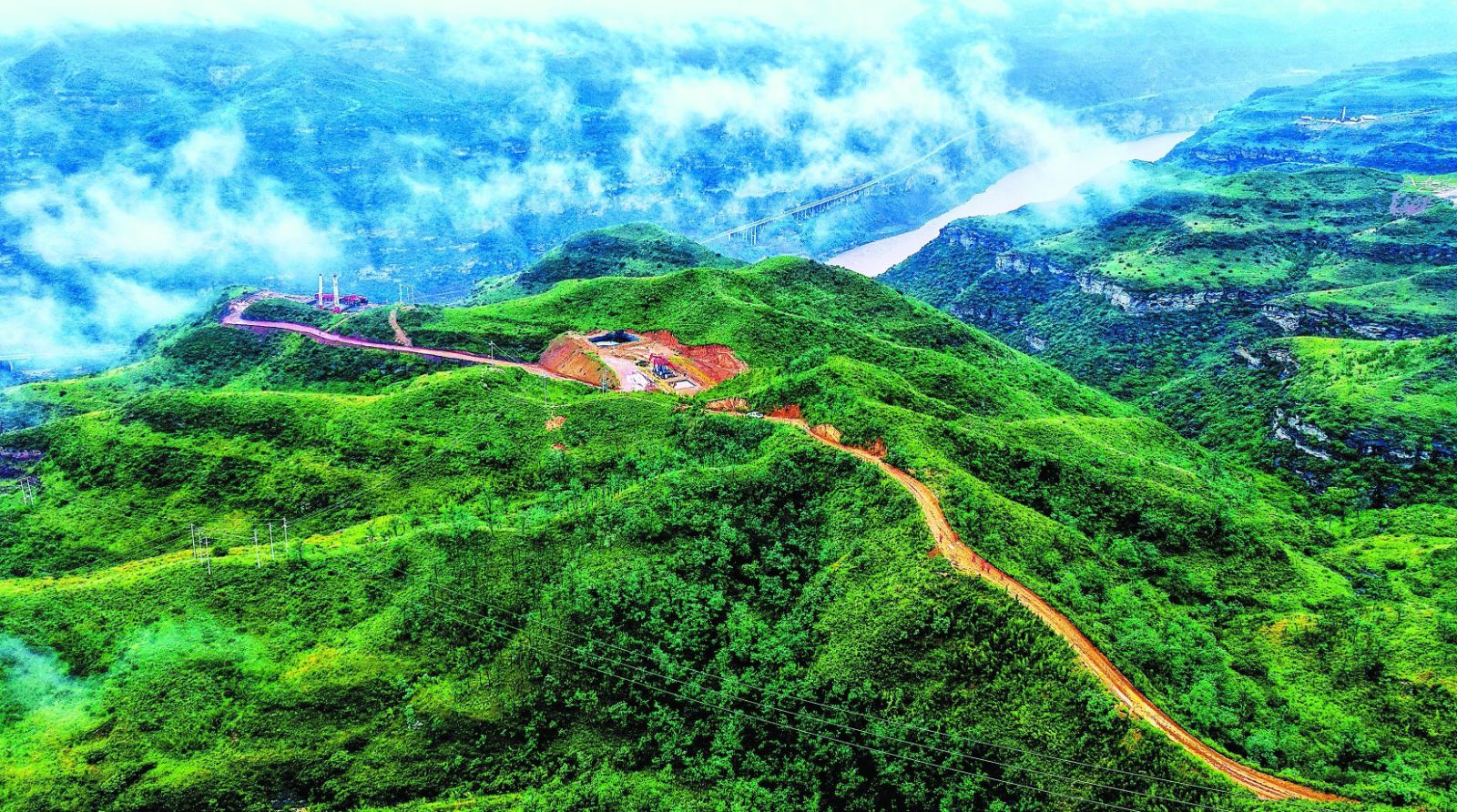
To accelerate the high-quality exploration and efficient development of deep coalbed methane, Sinopec recently held a special seminar on deep coalbed methane in Linfen City, Shanxi Province, and also held the unveiling ceremony for the Sinopec Key Laboratory for Exploration and Development of Deep Coalbed Methane. The experts present conducted in-depth discussions on the current situation and problems of Sinopec's coalbed methane exploration and development.
The text and images in this edition, except for those with attribution, were provided by Shen Zhijun, Ding Anxu and Guo Tao.
□ Reporter: Ma Ling, Ji Jiaxin
Our country's fossil energy resources are characterized by "abundant coal, scarce oil and insufficient gas". Coalbed methane, as a clean and efficient unconventional resource, its effective development is of great significance for disaster reduction in coal mines, environmental protection and energy security.
The global coalbed methane reserves exceed 270 trillion cubic meters, mainly distributed in Russia, Canada, China and the United States, accounting for approximately 89% of the total. Foreign coalbed methane is mainly of low-grade type, featuring low degree of evolution, good reservoir properties and high free gas content, and has formed a development technology system dominated by multi-branch horizontal wells and open-hole completions. The peak annual output of coalbed methane in the United States and Australia was 40-50 billion cubic meters.
Coalbed methane in China is distributed in various basins such as Ordos, Qinshui, Tuha, Junggar, Songliao, Tarim and Sichuan. Currently, the development is mainly focused on high-order coalbed methane, featuring high degree of evolution, poor reservoir properties and strong adsorption capacity. The resource volume is approximately 70.76 trillion cubic meters. Among them, the deep coalbed methane resources are abundant, with a resource volume of about 50.17 trillion cubic meters at a depth of 1,500 meters or deeper, accounting for 70.9%.
Since the "14th Five-Year Plan" period, the proven reserves of coalbed methane in China have increased by an average of 220 billion cubic meters per year, and the output has increased by an average of 1.43 billion cubic meters per year. The industry has maintained a strong development momentum. From 2022 to 2023, three trillion-cubic-meter-sized gas fields, namely Shenhufu, Dagiji, and Nalinhe, were discovered in the Ordos Basin, with an additional proven reserves of 447.5 billion cubic meters. In 2023, China's coalbed methane output reached 11.77 billion cubic meters, an increase of 20% compared to the previous year. The proportion of deep coalbed methane exceeded 15%, becoming a new growth point for natural gas reserves and output.
Coalbed methane has become an important alternative field for increasing reserves and enhancing production.
From the perspective of stratigraphic divisions, in China, mainly coal seams of the Carboniferous-Permian system are developed in basins such as Ordos, Sichuan, and Bohai Bay. The sedimentary environment is transitional between land and sea. The distribution area is extensive and the resource volume is large. Moreover, coal seams of the Jurassic-Cretaceous system are developed in basins such as Qargalai, Tuha, and Erlian, with a sedimentary environment of river-lake type. Some local coal seam thicknesses are relatively large and coalbed methane is abundant. The coalbed methane resources of different coal grades (high, medium, and low) are complete in structure, and each accounts for approximately one-third of the total geological resources.
In China, the early-stage deep coalbed methane evaluation wells were mainly located in the Ordos Basin. In 2016, China National Offshore Oil Corporation (CNOOC) initiated the exploration of deep coalbed methane. Subsequently, China National Petroleum Corporation (CNPC) and China Petrochemical Corporation also carried out exploration and evaluation. The development methods shifted from vertical wells to horizontal wells and cluster wells for efficient exploitation. The proportion of deep coalbed methane production has been increasing year by year.
The basins such as Ordos, Sichuan, Qinshui, Nanhuabei, and Bohai Bay mainly contain medium and high-grade coal, featuring high gas content and abundant free gas. Their resource volume exceeds 7 trillion cubic meters, with great exploration potential. The basins like Qargayi, Tuhai, Hailar, and Erlian mainly contain medium and low-grade coal, with good reservoir performance and a high proportion of free gas, but the gas content is relatively low, with a resource volume of nearly one trillion cubic meters. After preliminary selection and evaluation, the medium and high-grade deep coal seam gas resources in key areas of Ordos, Qinshui, Sichuan, and Bohai Bay are abundant, and they have the most promising development prospects, making them important resource replacement areas in the future.
The East China Oil and Gas Branch of Sinopec mainly conducts coalbed methane exploration and development in the two major coal-rich regions of North China and South China. In 2008, it was the first to sound the clarion call for entering the coalbed methane field. Facing the "three low" (low porosity, low permeability, and low pressure) challenges, it innovatively formed the "four-element coupling" geological theory of "deposition controls coal formation, preservation controls resource accumulation, ground stress controls permeability, and fracturing effective modification controls production"; boldly proposed the fracturing technology concept of "increasing flow rate, expanding scale, and strengthening sand laying"; explored the drilling operation mode of "branching, large platform, and well factory" and differentiated development technical policies. It built China's first deep coalbed methane field - the Yanchuan South Coalbed Methane Field. This gas field went through three stages: exploration and evaluation, capacity construction, and development adjustment. In 2015, it achieved a production capacity of 420 million cubic meters per year. After six years of continuous efficient production, as of now, the cumulative gas production has reached 3.06 billion cubic meters. In 2023, the East China Oil and Gas Branch in Guizhen, Guizhou Province, discovered an additional proven reserves of 11.3 billion cubic meters and discovered the second coalbed methane field of Sinopec.
After more than 10 years of continuous research and on-site practice, Sinopec achieved the efficient development of Yanchuan South, the commercial discovery of Jiading, and multiple breakthroughs in multi-type exploration in Daonidi, Nanquan, and Jinzhong. A total of 32.114 billion cubic meters of proven reserves were submitted, and 3.15 billion cubic meters of coalbed methane were produced. Coalbed methane has become an important successor field for Sinopec's natural gas reserve expansion and production, ushering in new opportunities for innovation and development.
Innovative understanding of the occurrence and enrichment mechanism of coalbed methane
Since the "14th Five-Year Plan" period, deep coalbed methane has broken through the traditional depth limits of understanding. In the Ordos Basin's Carboniferous-Permian strata, the Sichuan Basin's Permian strata, and the Junggar Basin's Jurassic strata, a series of strategic breakthroughs and significant progress have been made. Many wells have demonstrated high production and stable output, forming new frontiers for reserve expansion and production increase.
Sinopec has continuously innovated and improved its basic theories and technical systems. Through continuous exploration and research on the fundamental geological studies of deep coalbed methane, it has recognized that the low-sulfur, semi-bright-to-bright coal formed under a strong overlying water reduction environment is a favorable rock phase. The micro- and meso-pores it develops have relatively high pore volume, large specific surface area, well-developed fractures, and a high total porosity, which is conducive to the storage of adsorbed gas and free gas. There is a "critical depth" in the coal-rock adsorption performance. Due to differences in evolution degree, burial depth, and preservation conditions, the storage mode of coalbed methane varies. In areas with good preservation conditions, deep coalbed methane of medium and high-grade coal has the characteristics of high gas content and rich free gas (accounting for 20% to 25%), breaking the traditional understanding that coalbed methane is mainly adsorbed gas, and providing strong support for the expansion of coalbed methane to deeper layers.
The Daonidi gas field is a favorable area for the accumulation of deep coalbed methane. The North China Oil and Gas Branch of Sinopec has deployed and implemented the horizontal well Yangmian 1HF well for fracturing tests in the Daonidi gas field. The test achieved a daily production of 104,000 cubic meters, with a continuous and stable high production for one year, with an average daily production of 63,000 cubic meters, and a cumulative gas production of 27.38 million cubic meters. The vertical well Shi 103 well also achieved stable production for one year, with an average daily production of 20,000 cubic meters, and a cumulative gas production of 6.83 million cubic meters. This further confirmed that the deep coalbed methane in the Daonidi gas field has high production and stable production capabilities. In 2023, the Daonidi gas field submitted a predicted reserve of 122.7 billion cubic meters. At the same time, the Yang 2 well deployed and implemented by East China Oil and Gas in Chongqing Nanchuan achieved self-flowing daily gas production of 18,000 cubic meters, marking the first major breakthrough in the exploration of deep coalbed methane in the Sichuan Basin. The Jinzhong Jin 2 well in Shanxi tested a daily gas production of 11,000 cubic meters, achieving a new breakthrough in the exploration of deep coalbed methane in the Qinshui Basin.
The main problems in deep coalbed methane exploration are manifested as significant differences in resource endowment, the need to deepen the understanding of enrichment patterns, difficulties in predicting "sweet spots" due to thin coal seams and low drilling success rates of coal layers, unclear development patterns, difficulties in well formation of horizontal wells, and strong heterogeneity of coal reservoirs with high difficulty in modification. Expert Liu Zengqin from the Petroleum Exploration and Development Research Institute believes that efforts are needed to tackle issues such as the development of different types of deep coalbed methane calibration zones (standard models) and classification and grading evaluation techniques, deep coal reservoir characterization techniques, evaluation techniques for free gas in deep coal seams, prediction techniques for "sweet spots" in deep coalbed methane, and technology for selecting favorable areas in deep coalbed methane.
Strengthening integrated research on geological engineering and conducting on-site breakthroughs
Sinopec has been continuously exploring the laws of deep coal seam gas accumulation and high production. By analyzing the coal formation, hydrocarbon generation, storage, and occurrence characteristics of typical coal-bearing basins, the Petroleum Exploration and Development Research Institute has initially proposed the gas control mechanism of "favorable coal rock quality, good preservation conditions, and temperature-pressure coupling effect", and has preliminarily established a series of measurement and evaluation methods for deep coal seam gas reservoirs and "sweet spot" seismic prediction methods. They have also been striving to explore prediction technologies such as coal seam thickness, coal rock type, coal structure, and gas content, to support the selection of "sweet spot" layers. Based on the integrated selection of deep coal seam gas geological engineering areas, 10 favorable exploration zones have been selected, covering an area of 19,000 square kilometers and with a resource volume of 330 billion cubic meters.
According to the requirements of deep coalbed methane exploration, researchers aimed at the "sweet spot" evaluation and formed the following key technical sequence by the Petroleum Geophysical Research Institute: based on deep-domain processing for precise structural interpretation technology, to improve the imaging and identification accuracy of micro-deformations and small faults, with the structural error controlled within 1‰; post-processing frequency extension and multi-well constraint inversion technology, to conduct quantitative prediction of coal seams (bright coal); formation pressure and ground stress prediction technology, to achieve "sweet spot" evaluation of coal seams in engineering. Chief expert Bao Hongzhi of the Petroleum Engineering Research Institute pointed out that Sinopec has made significant progress in deep coalbed methane drilling speed-up technology, track design and trajectory control technology, well wall stability technology and high-performance water-based drilling fluid, coal seam cementing technology, "large flow rate, large liquid volume, large sand volume" reservoir modification technology, and efficient drainage gas production technology system.
In response to the geological characteristics such as thin coal layer thickness, good coal structure, moderate to high degree of coal evolution, high gas content, significant differences in mineral composition and rock mechanical properties of coal layers and their tops and bottoms, East China Oilfield has focused on achieving maximum economic benefits. Through research and development, they have successfully developed technologies for rapid drilling and completion of horizontal wells in the southern part of Yanchuan coal seam, as well as effective support for fracturing. They have also designed suitable well types in Tijianning, Jinzhong and Nanquan areas, optimized and improved the variable displacement fracturing technology centered on controlled perforation, and preliminarily explored and formed engineering process models for different blocks.
In response to the current situation of low production capacity of gas wells, rapid decline after reaching production, and absence of a stable production period, East China Oilfield has re-examined the characteristics of coal reservoirs. The deep coal rock has strong plasticity and well-developed fractures. Conventional fracturing techniques are difficult to form effective supporting fractures over long distances. They have conducted research and exploration to develop an effective supporting fracturing technology of "increased flow rate, expanded scale, and strengthened sand laying". The effective supporting fracturing wells exhibit "high initial liquid volume, quick gas production, high initial production, and strong low-pressure stable production capacity". They have established a "three-stage" drainage and production management model. During the drainage and pressure reduction period, they optimize the drainage and production process to achieve reasonable and rapid drainage. During the production and stable production period, they conduct meticulous management to control pressure and ensure stable production. During the decline period, they strengthen surface pressure boosting and old well treatment to delay the decline. This ensures the stable production of gas wells.
In response to the difficulties in stable horizontal well penetration through thin coal seams and the low drilling success rate, East China Oilfield proposed the concept of "effective drilling success rate", and focused on researching the key technologies for integrated development of "guidance - fracturing - production". The guidance was not blindly based on layer penetration, ensuring a smooth trajectory for production and recovery. Targeted and precise fracturing was adopted to expand the lateral coverage area. The sections where no coal seam was encountered were fully reformed, achieving efficient exploitation of deep thin coal seam horizontal wells.
The North China Oil and Gas Company continuously improves its drilling technology and has achieved initial results in speeding up and enhancing efficiency. To address the problems such as leakage and collapse of the upper strata, instability of the coal seam wellbore, strong heterogeneity, high-scale fracturing requirements, and high drilling and completion costs, they set the goal of "optimal and rapid safe well completion", integrating "wellbore structure optimization + strong inhibition and strong sealing composite salt drilling fluid + comprehensive geological guidance trajectory control + anti-mechanical disturbance drilling and well-up measures + elastic and resilient cement slurry cementing technology", to provide a high-quality wellbore environment for the later operations of deep coalbed methane. By adopting measures such as layer-by-layer approximation of marker layers, 85-degree well deviation to the top, bright coal warning line-controlled target windows, azimuth GR (natural gamma) for position determination, elemental logging for rock type determination, and adjustment of drilling pressure and well deviation, they have initially formed an integrated comprehensive geological guidance technology for deep coalbed methane geology engineering. Through the technical summaries and iterative improvements of 3 wells, they have initially formed wellbore structure optimization design, comprehensive geological guidance, strong inhibition and strong sealing drilling fluid, elastic and resilient cement slurry cementing, and other drilling technologies.
Challenges Faced by the Coalbed Methane Industry and Countermeasures Suggestions
The coalbed methane in our country has geological characteristics such as poor quality of coal reservoirs, strong heterogeneity, diverse accumulation types, and complex enrichment and flow mechanisms. The coalbed methane industry is facing challenges such as weak basic research, poor technical compatibility, and high difficulty in efficient development, which has restricted the large-scale and efficient development of coalbed methane.
The deep coal seam contains both adsorbed gas and free gas, and the storage conditions, occurrence patterns, and adsorption-desorption mechanisms are complex. The research on reservoir pore and fracture characterization, occurrence mechanism, and desorption diffusion and seepage process is not in-depth, which affects the selection of "sweet spot" targets and the optimization of development methods. At the same time, due to insufficient geological understanding in the previous stage, the old wells that have been deployed have deficiencies in fracturing techniques and well network deployment, and need to be re-evaluated through repeated fracturing methods.
Professor Guo Xusheng, an academician of the Chinese Academy of Engineering and the chief geologist of Sinopec and the president of the Petroleum Exploration and Development Research Institute, pointed out that after more than a decade of unremitting efforts, Sinopec has made progress in the exploration and development of deep coalbed methane. It has initially established development methods, and especially in recent years, the supporting engineering technology has also developed. He stated that it is necessary to steadily advance resource evaluation, increase the exploration efforts for deep coalbed methane, accelerate the construction of demonstration areas for deep coalbed methane, and promote high-quality exploration and large-scale efficient development of coalbed methane; strengthen basic research and systematic macro research to form a supporting technical system; conduct research on the enrichment and high-yield laws of different types of deep coalbed methane, carry out classification and grading evaluation of deep coalbed methane resources, and continuously tackle the supporting engineering technology for deep coalbed methane; improve the construction of the talent team for deep coalbed methane, increase cooperation and exchange efforts with domestic and foreign parties on deep coalbed methane; strengthen organizational coordination and management, and coordinate the scientific research system.
At present, the completion technology for horizontal wells in thick and thin coal seams is not yet mature. It is controlled by the differences in sedimentary conditions of the coal-bearing strata. The combinations of coal seam and roof rock properties, mineral composition, development degree of fractures, and roof stress vary greatly in different blocks, which affects the stability of the wellbore during horizontal well drilling. The coal seam is thin and it is located in a complex structural area, with frequent layering of the trajectory. The effective support fracturing technology under different coal and rock characteristics and roof rock combination conditions is not applicable. Under the condition of large-scale liquid injection and sand addition, the liquid production of gas wells is high, but the stable and efficient drainage and gas production technology is not mature. The drainage and production process is prone to interruption, and during the flowback process, the fracturing sand is prone to be returned and discharged, which affects the production capacity of the gas well.
He Xi Peng, the deputy general manager of East China Oil and Gas, believes that it is necessary to continuously strengthen the research on the types, existence status and storage-desorption mechanisms of coal reservoir storage spaces under different geological conditions, to identify the main controlling factors for deep coalbed methane accumulation in different blocks, and to guide the selection of "sweet spots" targets and the optimization of development methods; to intensify the technical research on the well formation technology of deep thin coalbed gas horizontal wells, and conduct research on the mechanism of well wall instability in deep coalbed gas wells, in order to achieve the core of "effective stress" support, and carry out exploration and experimentation on drilling anti-collapse and anti-kick technologies based on the optimization of well structure and the selection of drilling fluids, to gradually improve and optimize, and achieve safe and efficient well formation of deep coalbed gas horizontal wells; to continuously optimize the effective supporting fracturing technology under different geological conditions, based on the characteristics of in-situ stress, coal body structure and pore-fracture development in different blocks, to carry out targeted technical research, to achieve far-supporting fractures, and form reservoir fracturing renovation plans under different geological conditions; to deepen the research on the pressure diffusion mechanism of coal reservoirs and the evaluation of reservoir sensitivity, to continuously optimize the reasonable staged production and recovery system, to ensure that the pressure drop funnel spreads to the far end; to carry out technical research and experimentation on the prevention of sand and coal powder in the formation, to develop low-temperature solidification sand, establish sand barriers, prevent the fracturing fluid from carrying coal powder out of the ground, achieve source sand control treatment, reduce reservoir damage, and ensure the stable production of gas wells.
During the deep coalbed methane drilling process, due to the complex geological environment of the coal seam and insufficient geological understanding, the drilling and completion engineering encounters problems such as low efficiency, high cost, and difficulties in safely completing horizontal wells, which restricts the large-scale and efficient development of deep coalbed methane. Bao Hongzhi believes that it is necessary to strengthen the research on deep coalbed methane geology and geophysical exploration technologies, improve the accuracy of geological prediction, provide a foundation for the safe completion of horizontal wells, and conduct in-depth research on the mechanisms of various types of coal seam well wall instability and well wall stability technologies to ensure the safe completion of horizontal wells. We should also focus on the integrated trajectory control technology of geological engineering to increase the coalbed drilling rate. Strengthen the remote support of RTOC (Real-Time Remote Expert Support Center), provide real-time warnings and optimize parameters to ensure safe and smooth drilling. Deepen the research on anti-friction and anti-torsion and wellbore cleaning technologies to ensure safe and efficient drilling on large well platforms. Conduct research on the treatment technology for long bare section leakage and collapse to achieve the successful completion of secondary wellbore structure wells. Focus on the process technology and supporting fluids for different types of coal seams for volume modification and explore micro-foam and low-pressure fracturing technologies to further improve the adaptability and economic efficiency of fracturing modification.
Cao Shaolei, an expert from the Petroleum Geophysical Survey Technology Research Institute, believes that to enhance the production capacity of individual wells and promote the "limit development" model centered on EUR (estimated ultimate recoverable reserves), it is necessary to further improve the prediction accuracy of geophysical surveys, conduct deep coal seam gas rock physics experiments and modeling, and provide a basis for the selection of sensitive parameters of deep coal seam gas and the establishment of seismic identification models. Strengthen the introduction of new technologies such as 3D DAS-VSP (distributed acoustic sensing vertical seismic profile) and Q-RTM (visco-acoustic reverse-time migration), improve the imaging accuracy of deep coal-bearing strata, and carry out integrated research across multiple disciplines to effectively evaluate the fracturing effect of deep coal seam gas.
He Xipeng believes that in the future, coal seam gas exploration will expand from single coal seams, high-grade coal, and shallow layers to multiple coal seams, multi-gas co-production, medium-low grade coal, and medium-deep layers. In terms of development, new mining technologies such as multi-well types, differential modification, modified replacement, temperature increase for energy enhancement, and in-situ transformation will be explored. In terms of engineering, it will move towards low-cost, high-end, intelligent, and green-low-carbon development.

