
Interpretation of Changes in Industrial Pipeline Classification as Per GB/T 20801.1-2025
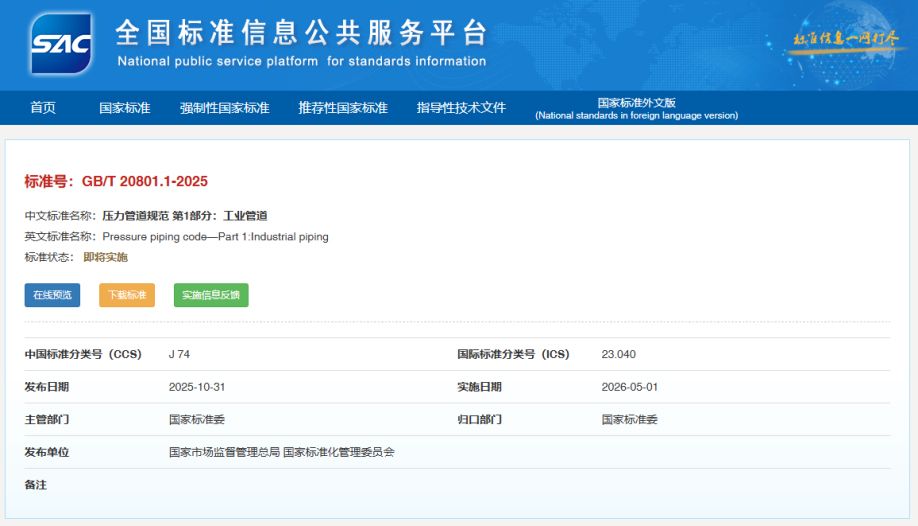
Figure / National Standard Technical Specifications
Industrial pipelines, as an important component of pressure pipelines, play a crucial role in the petrochemical industry. Their safety directly affects the normal operation of production facilities, the safety of people's lives and property, and the sustainable development of the environment. In 2025, the State Administration for Market Regulation successively issued two key standards: "Industrial Pipeline Safety Technical Regulations" (TSG 31-2025) and "Pressure Pipeline Code Part 1: Industrial Pipelines" (GB/T 20801.1-2025).
TSG 31-2025, as a special equipment safety technical specification, has mandatory effect and establishes the legal compliance baseline. It will be officially implemented on January 1, 2026. GB/T 20801.1-2025 is a national recommended standard, positioned as the coordinating standard for TSG 31-2025, providing technical implementation details, and will be officially implemented on May 1, 2026.
GB/T 20801.1-2025 has redefined the classification and grading system for pressure pipelines, maintaining a high degree of consistency with TSG 31-2025. Specifically, this is manifested in:
Revised criteria for determining the hazardous nature of the medium
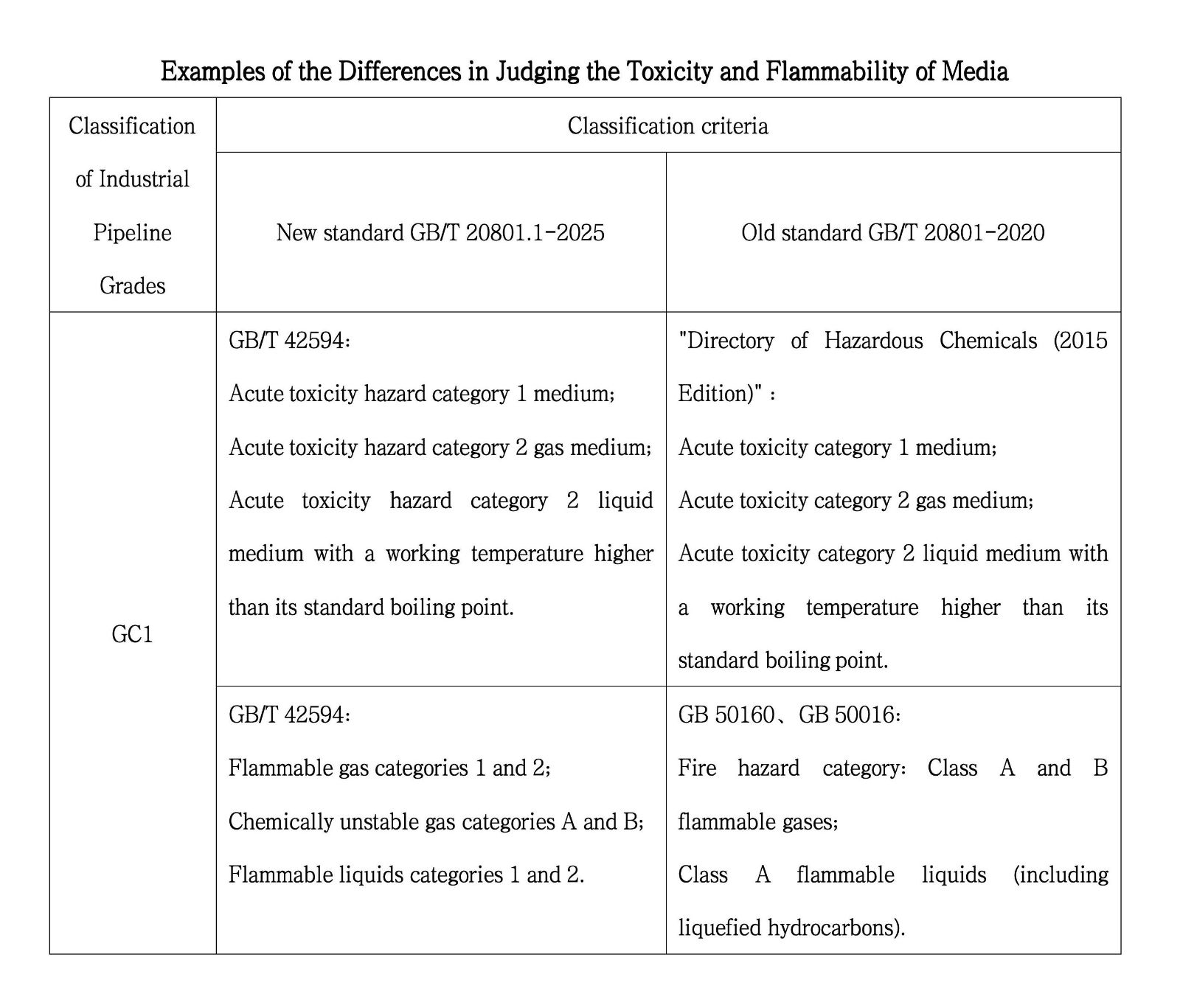
GB/T 20801.1-2025 clearly stipulates that for the classification of industrial pipelines, the toxicity of the medium is no longer determined based on the "Dangerous Chemicals Catalogue (2015 Edition)", and the flammability of the medium is no longer determined based on the "Design Fire Protection Code for Petrochemical Enterprises (2018 Edition)" (GB 50160-2008) and the "Building Fire Protection Code (2018 Edition)" (GB 50016-2014). Instead, the "Guidelines for Hazard Classification of Mediums in Pressure-bearing Equipment" (GB/T 42594-2023) is used as the unified determination standard.
GB/T 42594-2023 adopts a more international classification system, which is more in line with the Global Harmonized System for Classification and Labelling of Chemicals (GHS). For example, the acute toxicity hazard categories are divided into Categories 1, 2, 3 and 4, flammable gases into Categories 1 and 2, flammable liquids into Categories 1, 2, 3 and 4, and the newly added chemically unstable gases are classified into Categories A and B. Taking GC1 as an example, the differences in the determination of medium toxicity and medium flammability are shown in the following table.
Adjust the positioning of the GC3-level pipeline
According to the 3rd announcement of the State Administration for Market Regulation in 2019, the administrative licensing level for pressure pipelines has abolished the GC3 level, and only the GC1 and GC2 levels fall within the scope of supervision for pressure pipelines. In GB/T 20801.1-2025, the definition of the GC3 level has been retained, clearly defining it as "non-regulated category", which resolves the long-standing issues of unclear classification, positioning and supervision of GC3-level pipelines.
Summary
The simultaneous release and implementation of GB/T 20801.1-2025 and TSG 31-2025 marks the entry of China's industrial pipeline standard system into a new stage. The coordination and unification of the two standards in terms of pipeline classification rules not only enhance the technical advancement of the standards, but also improve the rationality and effectiveness of supervision, resolving the long-standing contradictions among standards and providing clear and definite guidance for the industry.

